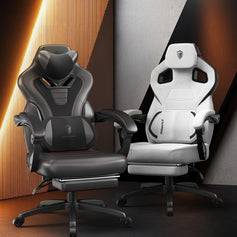


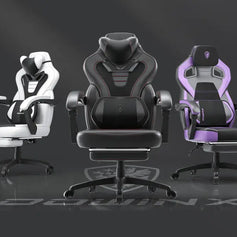
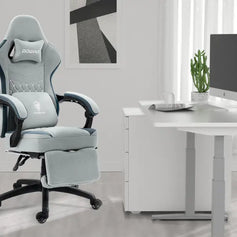


A properly designed big and tall office chair should involve more than simply widening the seat, raising the backrest and attaching a “300 lb” or “400 lb capacity” label.
At a minimum, it should meet three requirements:
- It must safely support a higher user weight.
- Its dimensions must genuinely accommodate larger-bodied or taller users.
- Its adjustment features must help users maintain relatively natural sitting positions while allowing them to change posture throughout the day.
The U.S. National Institute for Occupational Safety and Health, or NIOSH, describes ergonomics as designing work tasks and workplace demands around workers’ physical capabilities and limitations. Individual factors such as age, sex and body mass index may all influence ergonomic requirements.
1. The Weight Capacity Should Apply to the Complete Chair, Not Just One Component
A chair’s advertised weight capacity should represent the maximum load of the assembled chair under its intended conditions of use. It should not be inferred solely from the theoretical capacity of an individual component, such as the gas lift, base or casters.
The U.S. Occupational Safety and Health Administration, or OSHA, notes that most standard office chairs are designed for users weighing less than 275 lb, approximately 125 kg. When a user weighs more than 275 lb, the chair must be specifically designed to support the additional weight.
From a practical product-classification perspective, the following weight ratings may be used as general reference points:
- 300 lb, approximately 136 kg: an entry-level capacity for a big and tall office chair;
- 350 lb, approximately 159 kg: suitable for a broader range of medium-to-large users;
- 400 lb, approximately 181 kg: closer to the capacity expected from chairs designed specifically for heavier users.
These figures are useful market and product-development benchmarks rather than official government classifications.
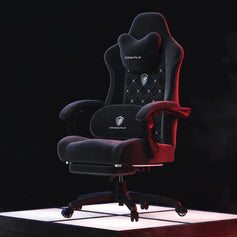
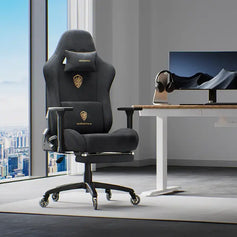
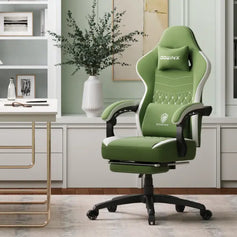
The Dowinx QL-66B6 Executive Office Chair has a maximum load of 330 lb, or 150 kg, placing it between the 300 lb entry level and the 350 lb category. Its support structure features an SGS-certified Class 4 gas lift and a five-star steel base, making it well-suited to the daily usage needs of most people.
2. Usable Seat Width Matters More Than the Chair’s Overall Width
OSHA recommends that the seat pan of a standard office chair be at least approximately 18 inches, or 45.7 cm, wide, and emphasizes that the seat should be at least as wide as the user’s thighs. Wider seats should be provided for larger users.
However, when purchasing or designing a big-and-tall office chair, the most meaningful dimension is not the chair’s total width from side to side, but rather:
The actual usable seat width between the armrests.
Thick armrests, side bolsters, and upholstery can occupy a substantial amount of space. A chair with an overall width of 70 cm may still provide only 47 cm of usable seating width.
From a product-segmentation perspective, the following practical guidelines may be used:
- A usable seat width below approximately 48 cm generally remains within the standard office-chair range.
- A usable seat width of approximately 50–52 cm can accommodate some larger users.
- A usable seat width of approximately 52–58 cm is more consistent with the positioning of a true big-and-tall office chair.
A properly sized seat should allow the user to sit centrally against the backrest without the hips or thighs being compressed by the armrests or seat bolsters. There should also be a small amount of clearance so the user can naturally change posture and stand up without difficulty.
OSHA notes that an excessively narrow seat can restrict movement and provide inadequate leg support. During prolonged use, it may also restrict blood flow in the legs, potentially causing irritation, numbness, or pain.
The QL-66B6 has a seat width of 24.8 inches (63 cm). The extra-wide seat design, paired with ultra-soft short-plush fabric, allows you to enjoy the comfort of a sofa while sitting in the chair.
3. Seat Depth Should Support the Thighs Without Pressing Behind the Knees
A deeper seat is not automatically a better seat.
OSHA’s purchasing guide provides a standard seat-pan length reference of 15–17 inches, approximately 38.1–43.2 cm, and recommends that seat depth be adjustable.
For taller users or people with longer legs, a standard-depth seat may not adequately support the thighs. A more appropriate design for a big and tall office chair would generally include:
- An effective seat depth of approximately 46–52 cm;
- Ideally, at least 5 cm of forward-and-backward adjustment;
- Enough adjustment to accommodate different leg lengths instead of relying on a single, exceptionally deep fixed seat.
To determine whether the depth is suitable, the user should sit with the lower back fully supported by the backrest and then check the distance between the front edge of the seat and the back of the knees.
The UK Health and Safety Executive, or HSE, recommends leaving a gap of approximately 2–3 cm between the front of the seat and the back of the knee. This allows the seat to support most of the thighs without creating excessive pressure in the popliteal area behind the knees.
When a seat is too shallow, part of the thigh remains unsupported and more pressure may be concentrated around the buttocks. When it is too deep, users may slide forward to avoid pressure behind the knees, causing the lower back to lose contact with the backrest. It may seem like a minor issue, but with long-term use, a mismatch in seat depth can cause you considerable discomfort.
4. The Seat-Height Range Must Accommodate Taller Users Without Sacrificing Foot Support
For big and tall office chairs, particularly those marketed to taller users, the upper end of the seat-height range is important.
A reasonable design may offer a compressed seat height of approximately 52–56 cm, allowing users with longer legs to sit without their knees rising significantly above their hips. OSHA’s broader purchasing guidance recommends an adjustable seat-height range of 15–22 inches, or approximately 38.1–55.9 cm.
Seat height, however, should never be selected on the basis of height alone. In an appropriate working position:
- Both feet should rest fully and securely on the floor or on a stable footrest.
- The front and back of the thighs should receive relatively even support.
- The thighs should remain approximately parallel to the floor.
- The knees should be close to hip level or slightly below the hips.
- The user should not need to sit on the front edge of the chair simply to reach the floor.
OSHA explains that a seat that is too high may leave the feet unsupported or encourage the user to slide forward. This removes support from the lower back and may contribute to fatigue, restricted circulation, swelling, numbness or pain. When the chair cannot be lowered sufficiently, OSHA recommends using a stable footrest.
The QL-66B6 has a seat-height range of 21.1–23.4 inches, or 53.5–59.5 cm, and is recommended for users approximately 5 ft 3 in to 6 ft 3 in tall, or 160–190 cm. Its relatively high seat range can be beneficial for taller users and those with longer lower legs. However, its minimum height of 53.5 cm is also higher than the minimum offered by many standard office chairs. Shorter users, or users with proportionally shorter legs, should confirm that both feet remain fully supported at the lowest setting.
The chair also includes a retractable footrest, which can be pulled out to transform it into a perfect resting place when you are tired.
5. Cushion Quality Should Not Be Judged by Softness and Thickness Alone
OSHA recommends that seat and backrest materials be firm, breathable and resilient. It also recommends a rounded, waterfall-style front edge to reduce contact pressure against the thighs and the area behind the knees.
For heavier users, an excessively soft seat may quickly create several problems:
- The hips may sink through the cushioning and come into contact with the underlying seat structure.
- The user may find it difficult to turn or change sitting position.
- The cushioning may develop permanent compression or sagging over time.
A properly designed big and tall office chair therefore requires stable support and long-term resilience, not merely an exceptionally soft feeling during the first few minutes of use.
The QL-66B6 uses a dual-layer cushioning system consisting of independent pocket springs, high-density foam and generous padding. This structure is intended to provide deeper support and resist premature flattening.
6. Even a Good Chair Cannot Eliminate the Risks of Prolonged Inactivity
No ergonomic chair, regardless of its size, cushioning or adjustability, can turn prolonged static sitting into a healthy activity.
The World Health Organization defines sedentary behaviour as periods of low energy expenditure while awake, including sitting, reclining or lying down. In adults, higher amounts of sedentary behaviour are associated with increased risks of all-cause mortality, cardiovascular disease, certain cancers and type 2 diabetes. WHO recommends that people of all ages limit sedentary time and replace part of it with physical activity of any intensity.
The QL-66B6 provides a 90°–135° lockable reclining backrest, an adjustable headrest and a retractable footrest. These features can help users vary their position between focused work, reading and rest. However, reclining remains a sedentary position and should not replace standing, walking or regular movement breaks.
The UK HSE recommends taking shorter breaks more frequently rather than taking longer breaks at widely spaced intervals. For example, taking or changing activity for 5–10 minutes every hour is generally preferable to taking a 20-minute break every two hours.
Whenever possible, users should leave the workstation and move around. At a minimum, they should stretch and change posture regularly.
Ultimately, a qualified big and tall office chair should be evaluated through a combination of verified load capacity, usable dimensions, body-specific fit, structural support and appropriate adjustability. A wider seat or a higher weight rating may be helpful, but neither measurement alone is sufficient. The chair must fit the individual user—and the user must still move.